
Exercise Snacks: The 1-Minute Habit That Protects Your Heart and Cuts Cancer Risk
TikTok has a workout for you. So does YouTube, Instagram, your coworker who just discovered calisthenics, and approximately every fitness brand that has ever existed. There is no shortage of content telling you to start a routine - HIIT, tai chi, mobility flows, the latest 30-day challenge. We are more bombarded with fitness information than at any point in history, and somehow that has made it harder, not easier, to know what actually matters.
And yet. Most people who sit at a desk for eight hours a day are missing the type of movement that might matter most. Not a new program. Not another thing to schedule. Something small but potent, and more doable than anything currently trending: the exercise snack.
What Is an Exercise Snack?
An exercise snack is a short, intentional burst of movement - one to three minutes, done with real effort - sprinkled into your workday. Not a loop of the office or bathroom break. Something that gets your heart rate up and leaves you gasping for breath. Something you actually feel.
Squats. High knees. Burpees. Sprinting up a flight of stairs and walking back down. One minute on, 15 seconds off, repeated twice.
You don't need equipment. You don't need to change. And the research behind it is more exciting than most of what gets posted on fitness accounts.
The Problem with Uninterrupted Sitting
Before we get to the solution, it helps to understand what's actually happening in your body when you sit for hours without moving, because it's more than stiffness and a sore back.
When your large muscle groups - legs, glutes, and hips - are inactive for extended periods, your body starts down-regulating an enzyme called lipoprotein lipase, or LPL. LPL is responsible for clearing fat from your bloodstream. When it drops, triglycerides accumulate, blood sugar regulation becomes less efficient, and cardiovascular risk climbs.
Research suggests this begins after as little as 60 to 90 minutes of uninterrupted sitting. And it happens regardless of how fit you are or whether you worked out that morning.
Your musculoskeletal system is taking a hit too. Research puts the prevalence of work-related musculoskeletal disorders in office workers at over 80%, most commonly affecting the neck, lower back, and shoulders. In my experience doing workstation assessments, most people haven't filed a formal complaint. But ask them to raise their hand if they've had neck or shoulder pain in the past month, and almost every hand goes up. People have normalized discomfort they don't have to live with. Your joints need movement to stay lubricated. Your hip flexors shorten. Your glutes, which are supposed to stabilize your pelvis and protect your lower back, essentially forget they exist after a full day in a chair.
And your brain is struggling too. The afternoon slump is not a caffeine deficiency. It's your brain telling you it needs blood flow. The brain consumes around 20% of your body's oxygen and energy, and it is acutely sensitive to the drop in circulation that comes with prolonged stillness. Research consistently shows that people who sit uninterrupted through the afternoon perform worse on attention and executive function tasks than those who take movement breaks.
Sitting is not neutral. It is an active stressor on your metabolism, your structure, and your cognition. The good news is that the fix is faster and simpler than you might think.
One Minute of Hard Effort. That's It.
I'll be honest, as someone who has done four-minute Tabata intervals and the seven-minute workout app, I've grown skeptical of the trend to shrink exercise down to its shortest possible duration. It can start to feel like we're just looking for permission to do less. But this is different.
Researchers have been studying what they call VILPA, or vigorous intermittent lifestyle physical activity. Not workouts. Just short, hard bursts of real effort scattered throughout the day. Things like climbing stairs, moving fast to catch the bus, anything to get your heart rate up in the middle of ordinary life.
What they found is striking. A study published in Nature Medicine followed over 25,000 people who didn't otherwise exercise for an average of 6.9 years. Those who did just three bouts of one to two minutes of vigorous activity per day saw a 38-40% reduction in all-cause and cancer mortality and a 48-49% reduction in cardiovascular mortality risk. Three bouts. One to two minutes each.
A 2025 study in Nature Communications followed over 73,000 people for eight years and found that one minute of vigorous activity is the equivalent of 53 to 156 minutes of light intensity activity for cardiometabolic outcomes.
The studies measured activity woven into daily life rather than structured workday breaks that I recommend, but the physiology is the same. If three brief bouts of hard effort distributed through your day has that kind of impact, doing them intentionally during your workday is a reasonable and well-supported application of the research and benefits the circulation of LPL.
Why Your Morning Workout Isn't Enough (On Its Own)
This is the part that surprises people.
The LPL suppression and the metabolic consequences of sitting aren't solved by exercising harder or longer before work. Researcher Dr. Marc Hamilton has called this "inactivity physiology", a separate field from exercise physiology, because the mechanisms driving what happens when you sit all day are distinct from what happens when you exercise. Your morning run doesn't cancel out eight hours in a chair. They operate on different systems.
Brief movement interruptions throughout the day are what interrupt the inactivity signal. Not a longer workout. Not a standing desk. Actual movement, repeated, throughout the day. Your body is responsive. It just needs to be asked, repeatedly.
A Note on Walking
Walking is good for you, being in nature is good for you, and if you eat lunch at your desk, getting outside for even 10 minutes afterward is one of the simplest things you can do for your blood sugar and digestion. Do that.
But walking and exercise snacking are not the same thing and they're not interchangeable. A gentle walk doesn't drive the same metabolic response as one to two minutes of hard effort. They complement each other. Pick both.
The Human Side of Ergonomics
Most people think of ergonomics as the workstation - the chair, the monitor height, the keyboard position. And that matters. But ergonomics is really about the whole human in the system: how your body responds to the demands placed on it over the course of a day, how fatigue accumulates, how movement and rest interact. Exercise snacks are ergonomics in that fuller sense. They are a way of designing your day around how your body actually works, not just how your desk is set up.
If you want to understand the workstation side of that equation, Ergonomics Simplified is a good place to start.
How to Start
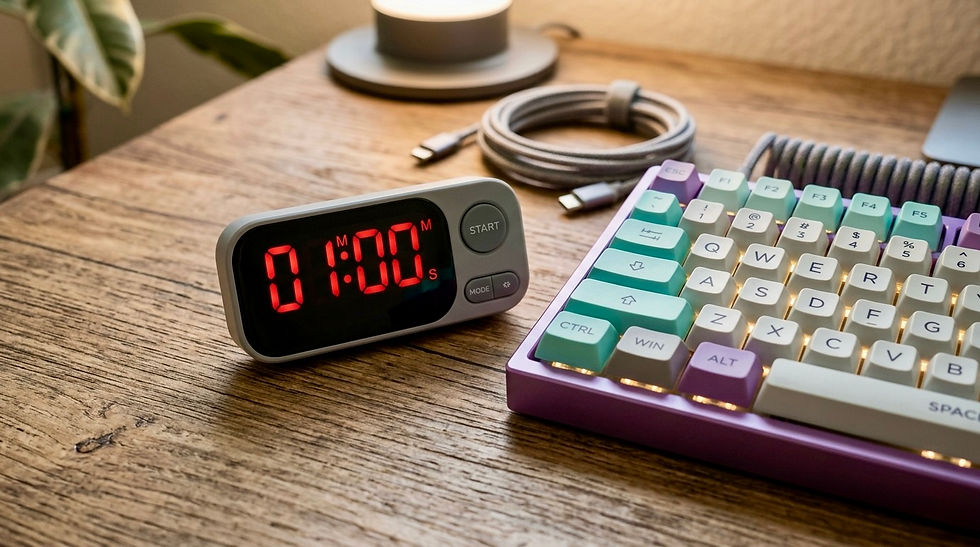
Set a timer for every 30 to 45 minutes. When it goes off, do something that makes you slightly breathless for one to three minutes. Then sit back down.
Some options:
Bodyweight squats: 1 minute on, 15 seconds rest, repeat
High knees
Sprint up a flight of stairs, walk back down, repeat
Burpees if you're feeling ambitious
Chair squats if you're just starting out
One minute of running while sitting in your chair - straighten your elbows and pump your arms like they are pushing down on big springs
That last one sounds easy until you try it. I did a training with a group of office workers and had everyone do exactly that. We were all out of breath. For some people it was the longest one minute they'd had in a while. Before we started, I had everyone do a body scan. After one minute, I had them do it again. The difference was immediate and noticeable to every single person in the room. One minute. Short but profound.
The app Pomodoro can double as a movement timer if you want a built-in prompt.
More in this series coming soon, including snacks for your shoulders and a full-body routine built for desk workers.
The Bottom Line
You don't need another workout program. You need one minute, a few times a day, where you actually move.
The research is not ambiguous. Brief, vigorous effort sprinkled throughout a sedentary day has a measurable impact on your heart, your cancer risk, and your long-term health. More impact, in some cases, than far longer bouts of gentle movement.
Your workstation and your movement habits work together. If you want an expert eye on both, I offer ergonomics assessments for individuals and organizations.
FAQ
Q: What is an exercise snack?
A: An exercise snack is a short, intentional burst of vigorous movement lasting one to three minutes, done several times throughout the day. Examples include bodyweight squats, high knees, stair sprints, and burpees.
Q: How many exercise snacks should I do per day?
A: Research suggests three bouts of one to two minutes of vigorous activity per day is associated with significant reductions in cardiovascular and cancer mortality risk.
Q: Are exercise snacks as effective as a full workout?
A: Exercise snacks and traditional workouts serve different purposes. Prolonged sitting creates metabolic consequences that a morning workout doesn't fully offset. Brief vigorous movement breaks throughout the day interrupt inactivity physiology -- a separate system from exercise physiology.
Q: How often should I take movement breaks at work?
A: Every 30 to 45 minutes is a good target. Even one to two minutes of vigorous effort each time has measurable metabolic and cognitive benefits.
Q: Can I do exercise snacks at my desk?
A: Yes. Chair-based movements like seated high knees with arm pumping can elevate your heart rate effectively without leaving your workspace.


Comments